|

In the ABDNHA
Desert Store
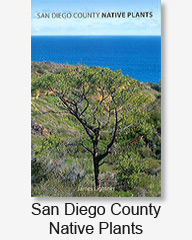
San
Diego County Native Plants Third Edition provides
a comprehensive photographic guide to the flora of the region.
|
|
ANZA-BORREGO PLANTS AND FLOWERS
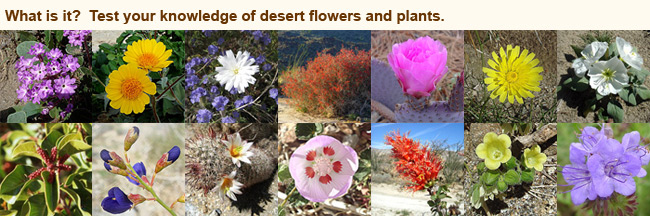
| Desert
Wildflowers: Why they appear when they do. |
There is no doubt that a broad carpet of wildflowers spread out across
the desert floor is one of the main attractions that bring visitors to a
desert environment. The fact that the bloom can vary widely from year
to year, with many years in a row having very few flowers, makes the
bloom years even more appealing and draws large crowds.
The
unpredictable nature of the bloom, and the reasons behind it, is a
fascinating story in itself. This is the way that desert plants have
adapted to an unpredictable environment in which water is scarce. The
primary objective of any living organism, the most important thing that will
carry it forward from one generation to the next is its ability to
reproduce. Living things that have mastered this single challenge
within the environment where they live can insure their survival over
thousands or tens of thousands of years.
In the desert the seeds of
desert annuals may lie in the ground for many years. They will not
germinate until there is sufficient moisture and warm temperatures. In the
case of Anza-Borrego, this moisture comes in the form of winter rains,
steady rains that penetrate the soil during the period from December to
February, with the second ingredient, warm temperatures,
normally arriving in February or March. The seeds are genetically
pre-programed to germinate only when there is enough moisture in the soil to
sustain them long enough to produce the flowers that will produce more
seeds. They can do this within a period as short as one or two weeks.
Once they have produced flowers and the seeds have fallen back to the
ground, their job is done. The seeds will patiently wait there until
the next time that conditions are just right and they will do it all again.
This makes for a very short lifespan for the individual plants that make up
a species that may continue to exist for thousands of years.
Once a
bloom has started the lifespan of the individual plants themselves will be
determined by the weather and the amount of water in the ground. If it
is not so hot to dry them out, or if some supplemental rainfall occurs after
they have emerged from the ground, they may prosper for more than a month.
But if conditions are hot and dry they will get their essential work done in
a much shorter time, produce flowers that quickly go to seed and the plants
will rapidly fade away. With their seeds safely in the ground they are
prepared to wait for the next spurt of life that will take place whenever
water next appears. Then they do it all over again.
|
|

|
If you love desert plants and flowers and you want to share what
you find on your Anza-Borrego outings, then we have a way you can get involved!
Send us your flower reports! Tell us what you are seeing
and where you are seeing it. Or just join our email list and we will send
you updates.
We cannot use each and every report or photo that
we get as we will try to provide fresh information without too many repeats.
But don't be discouraged, your photos will be held and may be used in the future.
It is easy to make your report:
-
You can use the form
below to send your report or subscribe to the general ABDNHA email list.
-
You can email your reports and pictures to
abdnhaprogram@att.net. This is
best if you have more than one photo.
-
You can text reports
and/or pictures directly from your phone to 760-538-3476. -
You can even stop by in person and tell us what you saw! The ABDNHA Nature Center, 652 Palm Canyon
Drive, one block west of Christmas Circle.
- WILDFLOWER REPORT
& ABDNHA MAIL LIST -
<a href="https://secure.blueoctane.net/forms/8LIKJICKKPBP">Click Here To Load This Formexperts.com Form</a>
Note: If you want to send more than one photo with your report, it will be best
to email them to abdnhaprogram@att.net
|
|
|
|
|
|
|

|
